
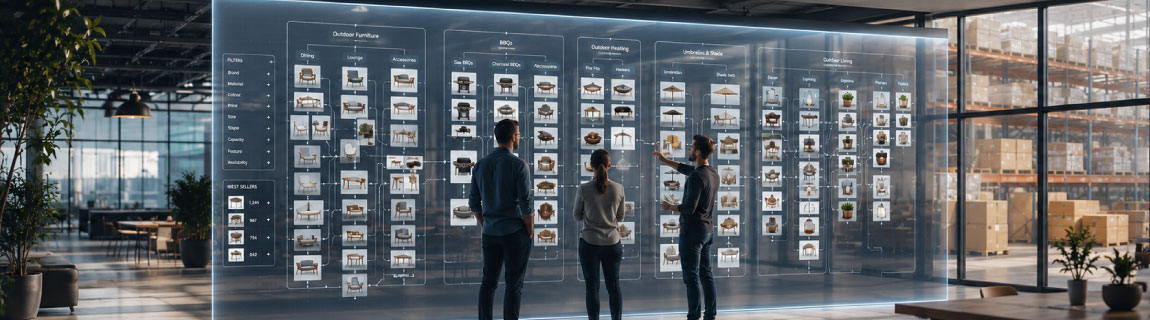
Most eCommerce businesses invest heavily in their website, ERP integration and marketing, yet one of the most important foundations is often overlooked.
Product category architecture.
Poor category structures make it harder for customers to find products, reduce search visibility, confuse AI search engines and increase the complexity of managing large product catalogues.
The reality is that many online stores simply inherit the category structure from their ERP.
While this might make internal administration easier, it rarely reflects how customers actually shop.
A successful category structure should balance three objectives:
- Customer experience
- Search engine visibility
- Operational efficiency
When these are aligned, customers find products faster, Google understands your catalogue more effectively and your merchandising team gains a far more scalable platform.
In this guide we’ll explore how leading retailers design category structures that improve usability, SEO and long-term business growth.
Why ERP Category Structures Usually Don’t Work Online
Most ERP systems were never designed to create intuitive online shopping experiences.
Their product hierarchies were built for:
- inventory management
- purchasing
- warehouse operations
- supplier reporting
- accounting
Those priorities are completely different from the needs of an online customer.
An ERP might categorise products like this:
- Electrical
- Lighting
- Internal
- LED
- Commercial
While technically accurate, a customer is much more likely to search for:
- Kitchen Lighting
- Pendant Lights
- Bathroom Lighting
- LED Downlights
The ERP structure makes perfect sense internally. However, one of the biggest mistakes businesses make during an eCommerce implementation is exposing ERP logic directly to shoppers.
Instead, your website should present products the way customers naturally think.
The ERP should remain the operational system.
The website should become the customer experience.
Customer-First Category Architecture
Good category architecture starts with customer behaviour.
Ask questions such as:
- What would a customer search for?
- What terminology do they use?
- How would they naturally browse?
- Which products belong together?
- What buying journey are they following?
For example, a plumbing supplier might organise products internally by manufacturer.
Customers rarely shop that way. Instead they think in projects.
- Bathroom
- Kitchen
- Laundry
- Hot Water
- Drainage
Within those sections they then narrow down to product types.
This approach significantly reduces the number of clicks required to reach a product while creating much more meaningful landing pages for search engines.
Customer-first architecture almost always outperforms ERP-first architecture.
Categories Are for Navigation
Categories should answer one simple question:
“What type of product is this?”
Examples include:
- Office Chairs
- Running Shoes
- Bathroom Vanities
- Coffee Machines
Categories should remain relatively stable over time.
They become the permanent structure of your website.
This consistency helps:
- customers
- AI systems
- internal linking
- merchandising
Changing categories every few months creates confusion and weakens accumulated SEO authority.
Treat categories as long-term assets rather than temporary marketing campaigns.
Collections Serve a Different Purpose
Many modern commerce platforms, particularly Shopify, support collections.
Collections allow products to appear in multiple locations without duplicating data.
For example, a product could simultaneously appear in:
- New Arrivals
- Best Sellers
- Winter Sale
- Staff Picks
- Outdoor Living
- Under $100
None of these should become permanent product categories.
They’re merchandising tools.
Think of categories as the structure of your store.
Think of collections as promotional experiences layered on top.
When used correctly they increase product discovery without complicating navigation.
Categories vs Attributes
One of the most common mistakes we see is turning every product attribute into a category.
Imagine selling televisions and creating categories like:
- 55 Inch TVs
- 65 Inch TVs
- OLED TVs
- 120Hz TVs
- HDMI 2.1 TVs
This creates an explosion of nearly identical category pages.
Instead, these should remain attributes.
The primary category may simply be:
Televisions
Customers can then refine results using filters for:
- Screen Size
- Resolution
- Brand
- Refresh Rate
- Operating System
This approach keeps navigation clean whilst assisting customers to narrow down large catalogues.
The Power of Faceted Navigation
As product catalogues grow, categories alone become insufficient.
This is where faceted navigation becomes essential.
Filters allow customers to progressively narrow large product lists without creating hundreds of unnecessary categories.
Typical filters include:
- Brand
- Colour
- Material
- Size
- Width
- Height
- Voltage
- Compatibility
- Price
- Availability
Well-designed faceted navigation dramatically improves product discovery.
However, every filter combination potentially creates a new URL.
Without proper technical controls this can generate thousands of duplicate pages.
Platforms should carefully manage which filtered pages are crawlable and which should remain excluded from search engines.
Designing Categories for Google
Every major category page should be treated as an important landing page.
Rather than simply displaying products, each category should contain:
- Unique introductory copy
- Descriptive headings
- Helpful buying advice
- FAQs
- Links to related categories
- Related products or up-sells
This gives Google much richer context than a basic product grid.
For example, instead of:
- Bathroom Tapware
Create a comprehensive landing page discussing:
- Types of tapware
- Finishes
- Installation considerations
- Matching accessories
- Popular brands
This creates pages that attract informational and commercial searches simultaneously.
Category Pages Are Becoming Important for AI
Large language models don’t browse websites the same way humans do.
They build an understanding of relationships between products, topics and entities.
Well-structured category pages help AI understand:
- Product groupings
- Industry terminology
- Buyer intent
- Semantic relationships
Instead of isolated product pages, AI increasingly prefers rich topic hubs.
A comprehensive category page becomes a source of authority.
This benefits both traditional search engines and AI-powered search experiences.
Breadcrumbs Improve More Than Navigation
Breadcrumbs provide customers with orientation.
They also communicate hierarchy to search engines. For example:
- Home > Outdoor Furniture > Dining Sets > 8 Seat Dining Sets
This helps Google understand:
- Page relationships
- Topical relevance
- Website architecture
Breadcrumb structured data also improves search listings by displaying breadcrumbs instead of long URLs.
For large catalogues, breadcrumbs become an important component of technical SEO.
Internal Linking Builds Authority
Every category should support related categories.
For example, a page about Coffee Machines might naturally link to:
- Coffee Beans
- Coffee Grinders
- Milk Frothers
- Water Filters
- Cleaning Products
These contextual links improve:
- User engagement
- Crawl efficiency
- Page authority
- Cross-selling
Many retailers overlook this opportunity, relying only on menus.
Strategic internal linking creates stronger topic clusters that benefit both users and search engines.
Mobile Navigation Matters More Than Ever
More than half of online shopping sessions now begin on mobile devices.
Complex desktop mega menus rarely translate well to smaller screens.
Successful mobile navigation should prioritise:
- Shallow category hierarchies
- Expandable menus
- Search prominence
- Quick filtering
- Recently viewed products
The fewer taps required to reach a product, the better the experience.
Testing navigation on real mobile devices should form part of every eCommerce project.
Category Landing Pages Should Educate, Not Just Sell
Many retailers miss an enormous opportunity by publishing category pages containing nothing more than products.
Instead, category pages should become buying guides.
Include content such as:
- How to choose the right product
- Comparison tables
- Common mistakes
- installation tips
- Downloadable guides
- Frequently asked questions
- Videos
- Related articles
This increases:
- Time on site
- Customer confidence
- Search visibility
- AI discoverability
This also creates more opportunities for internal linking into your broader content strategy.
Building Categories That Scale
As your catalogue grows, category architecture becomes increasingly important.
Before launching or restructuring your website, consider these questions:
- Can customers find products in three clicks or fewer?
- Are categories based on customer language rather than ERP terminology?
- Are attributes being used appropriately instead of creating unnecessary categories?
- Do category pages contain unique, helpful content?
- Are breadcrumbs and structured data implemented correctly?
- Does faceted navigation improve discovery without creating SEO issues?
- Are category pages internally linked to related products, collections and buying guides?
- Does the structure work equally well on desktop and mobile?
- Will the architecture still make sense if your catalogue doubles in size?
A scalable category structure supports growth without requiring constant redesign.
Getting this foundation right early can save thousands of hours of rework while improving customer experience, search visibility and conversion rates.
Final Thoughts
Product categories are far more than a navigation menu.
They influence how customers shop, how search engines crawl your website and how AI systems understand your catalogue.
The strongest eCommerce businesses don’t simply organise products.
They design category architectures that balance customer behaviour, operational efficiency and long-term SEO performance.
If you’re planning a new eCommerce platform, migrating from a legacy system or reviewing your product data strategy, category architecture should be one of the first conversations you have. A well-planned structure provides a foundation that supports merchandising, marketing and growth for years to come.